





By Eli Mendez-Garcia —
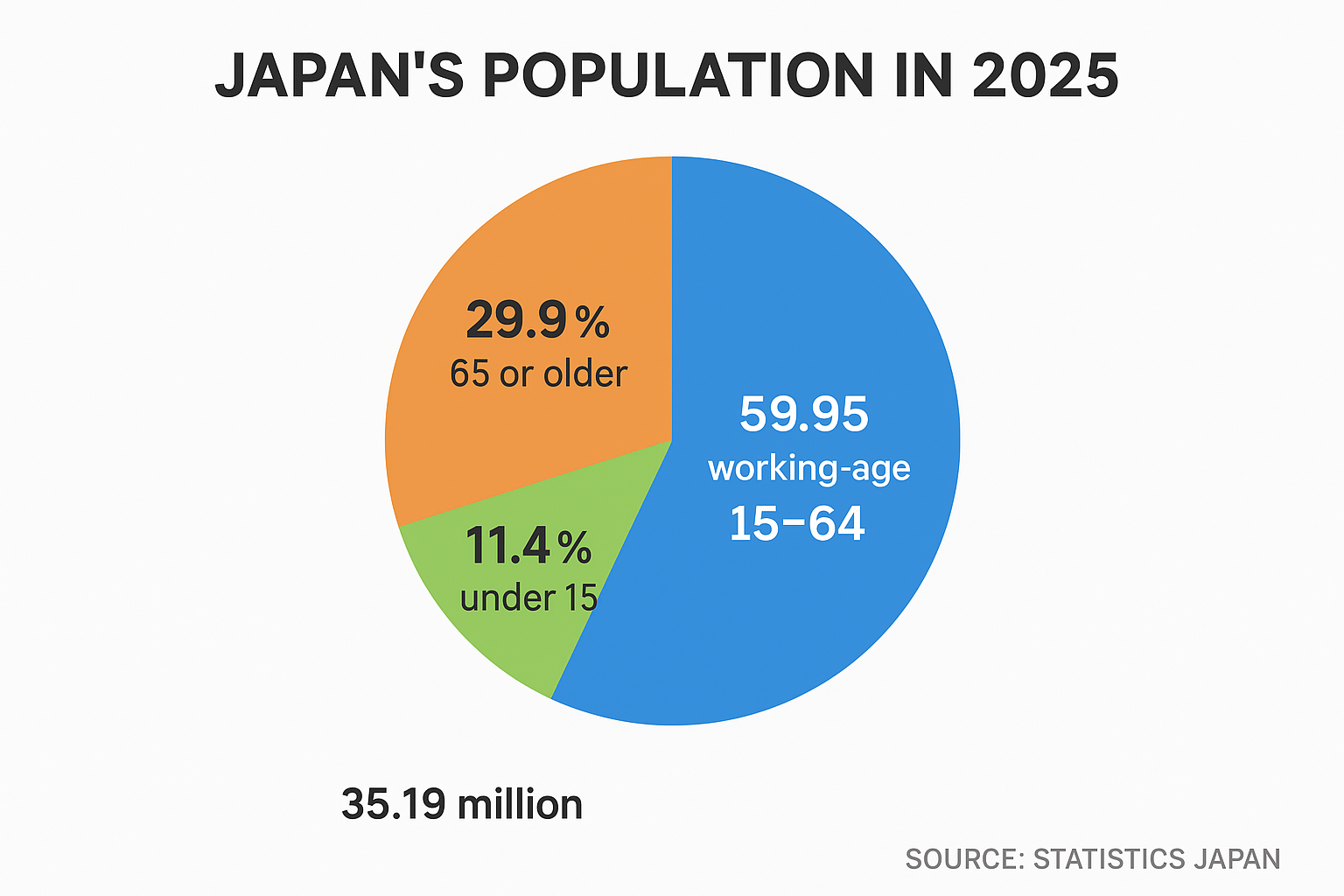
In Japan, this year is a momentous year. It is the year of the “2025 Problem,” when society officially becomes worryingly “top heavy.” It is the year that the last of its Baby Boom generation turns 75.
“The worry is that Japan’s current and future working population is too small to bear the financial burden of the social, health and welfare system that Japan has come to expect,” says Leo Lewis of the Financial Times. “Japan’s total fertility rate — that’s the average number of children that a woman would have over her reproductive years — has been among the world’s lowest for about 70 years now.”
During the 1970s and ’80s, demographers warned of a world population bomb, out-of-control birth rates exhausting the world’s resources to the point of human extinction.

The demographers, widely heeded in the developing world, were wrong. The real population bomb NOW is not an explosion; it is an implosion. Populations, even while they continue to grow via momentum, are projected to start falling — especially in the West.
The implications are twofold: One is retirees won’t have the medical services they expect because the economy lacks the engine (a big workforce) to pay for it. Two is potential civilization collapse; Elon Musk foresees a Europe that becomes extremist Muslim as traditional Europeans are not having kids while migrants are mass-producing babies.
Japan is not the only country to face the time bomb of population collapse. It is only the first to reach tipping point. (It is also one of the most capable of handling it because of so many top-of-the-line international companies and economic prosperity.)
More than 70% of the global population now lives in countries below replacement fertility (2.1 per woman). East Asia has the lowest fertility rate in the world, followed by Southern Europe. America is at 1.6, the UK is 1.5.
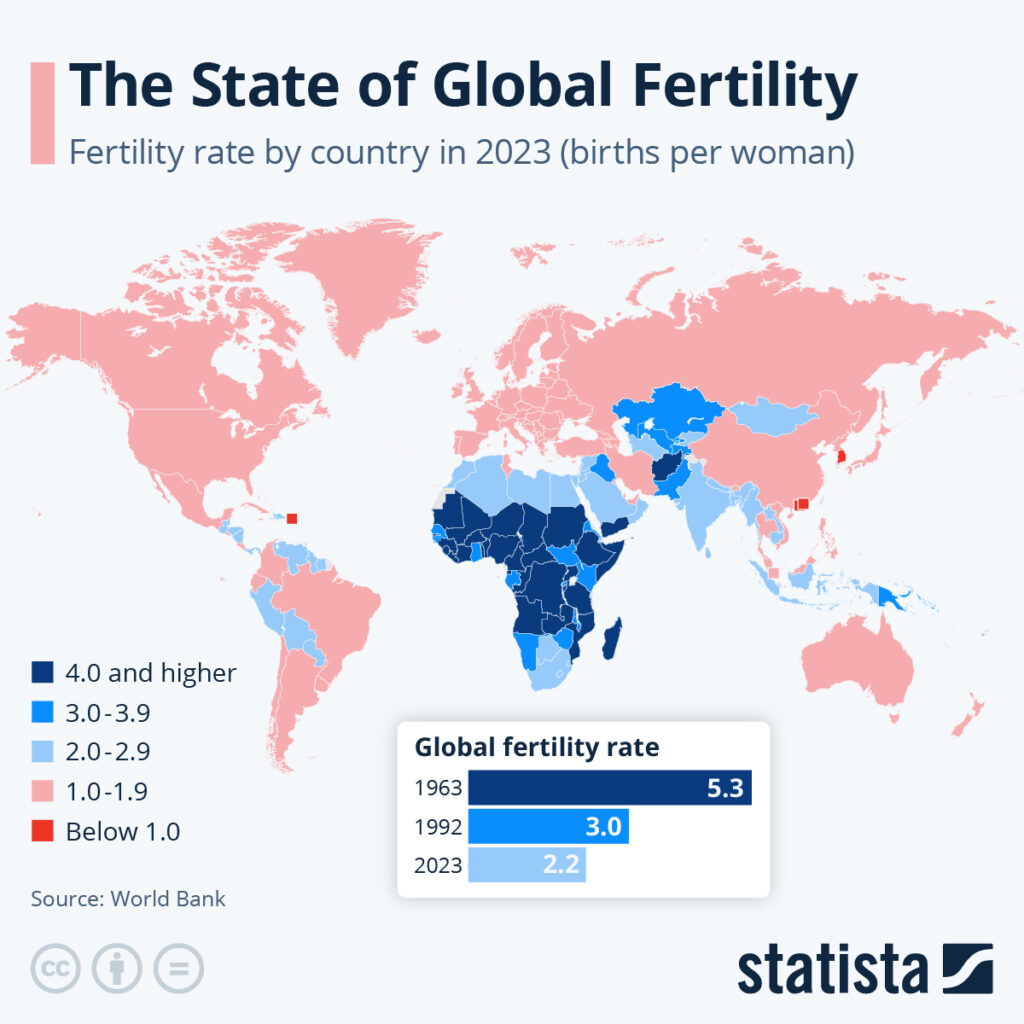
China, which thought it was overpopulating per resources, enforced a strict 1-child-per-family policy 1975-2015. Now, China is facing a shrinking workforce that threatens to destroy its economic prowess. China realized the economic danger too late; despite NOW encouraging people to have kids, it’s fertility rate is paltry 1.1.
In many Western nations, the short-term negatives of population decline is being offset by immigration — which is good in America but has major drawbacks for Europeans.
In Europe, extremist Muslim immigrants are openly threatening to take over and impose Islam on everybody. Vice President J.D. Vance criticized the UK saying it would become the first Muslim nuclear power nation, a worrisome prospect given the willingness of extremists to use unusable/deterrent weapons
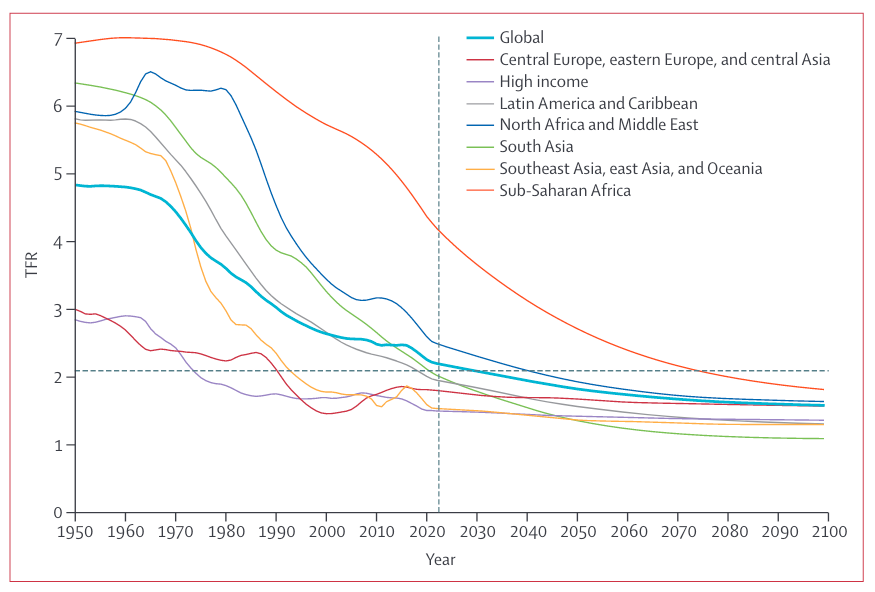
While “civilizational collapse” is a disturbing specter, the first problem is simply economics: how will a shrinking workforce pay for the social expenses of a growing population of retirees?
America’s Social Security system is funded by the current working population. It is essentially a Ponzi scheme, illegal for financial professionals but allowed when set up by the government. The money you “pay in” to Social Security is NOT saved for you; it’s spent on existing retirees. Your retirement will be paid by the next generation of workers.
What makes Ponzi schemes bust is a sudden stoppage, or a significant reduction, of incoming payees. Social Security faces this very real possibility.
Western European economies are even more socialist, giving more governmental services than America.
Nobody, having paid into Social Security for all their working life, is going to want to receive less than current minimums when they retire.
Japan — with decades of prosperity behind it and strong social stability — is probably the best poised country to handle the demographic imbalances. China may be in a bad spot
In the meantime, there is a simple solution to declining fertility rates: start having three babies every family. “People who have kids do need to have 3 kids to make up for those who have 0 or 1 kid or population will collapse,” Musk posted on X.
Related: The brown brother IS our brother, a case study in how Islamist minds think. Sources: Quillette, Financial Times, others.
