




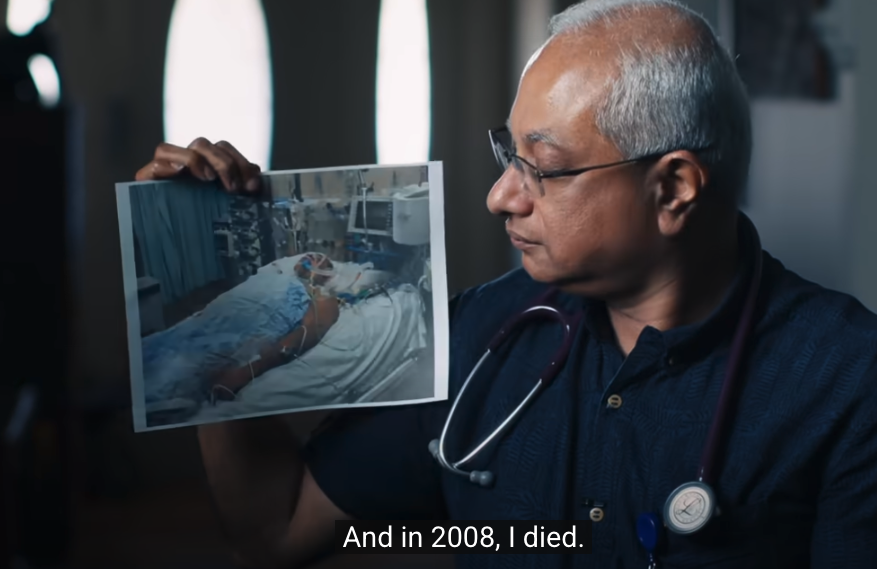
By Karine Keyser—
He was dead for 85 minutes, well over the 20 minutes that it takes the brain to irreversibly die.
Miraculously, Dr. Sean George, a Christian and the Head of the Department of General Medicine at Kalgoorlie Hospital in Western Australia, came back to life and was perfectly normal following his experience.
“I remember going and holding his hand, and it was so cold. And I thought, ‘I have lost my best friend,’” his wife said.
In this moment, Dr. Sean had been flatlining, and none of the doctors had any hope that things would change because it was medically impossible for someone to come back to life at this point and not be a vegetable.
“I can certainly say that, that was one miracle I’ve seen,” said Dr. Mark Thomas, a kidney doctor who cared for and witnessed Dr. Sean’s condition.
Everything started when Dr. Sean felt an uncomfortable sensation in his chest when he was driving home from a yearly clinic 400 km from his home in Kalgoorlie, Australia, in 2008.
“It was not a pain, but it was just a slight discomfort. And I thought, “Oh, it must be something that I ate,” he said.
He later pulled over after the discomfort turned into nausea. He also called his wife, who was also a doctor, to tell her where he was in case anything happened.
“I hopped back into the car and I turned into Kambalda, and I started to drive down that road,” he said. “But while I was traveling on that road, I really felt a deep conviction in my heart that I need to actually get into the clinic at Kambalda.”
After getting an ECG and looking at his own chart, as the single doctor who worked at the clinic was on his lunch break, he realized he was having a heart attack.
“At this stage, I was getting very anxious, and that’s the honest truth ’cause I was not looking at someone else’s ECG, I was looking at mine,” he said. “Basically, at that stage, I started to actually have quite a lot of chest pain. And I told the nursing staff, ‘Can you please call the doctor who is at lunch and ask him to come because I need help.’”
Shortly after the doctor returned to the clinic and checked on Dr. Sean, he passed out.
“I knew what the outcome was gonna be. I thought I did,” he said. “ What I was told by the doctors who were there on the day was that I actually had a seizure, and that was it, I was in cardiac arrest.”
The doctor and Sean’s intern then connected him to the defibrillator and started CPR.
“Generally people, when they come round, they generally come around after the few shocks,” he said. “That’s when you normally get the good outcome.”
Usually, between every shock, two minutes of CPR need to be done while the machine analyzes whether or not the heart needs to be shocked again.
Over the course of 48 minutes, Dr. Sean was shocked 13 times.
“But after 48 minutes, when the machine actually analyzed the rhythm, it did not actually recommend a shock because from the state of ventricular fibrillation,” he said. “I progressed into a flat line.”
David Paul Davies, a paramedic for Saint John’s Ambulance, said that there was no way anyone could survive a flatline, which in medical terms is called asystole.
“Asystole means there was not a skerrick of activity. His heart wasn’t moving, it was just a dead heart,” said Dr. Steve Dudley, a professor of Emergency Medicine.
After his wife learned that he had gone through a cardiac arrest, she called her dad to tell him the news, and while her dad was crying, he told her that she needed to go to her husband and pray.
His wife arrived as quickly as she could drive the 60 km it took to get to the clinic that Dr. Sean was at.
The doctors continued to attempt to revive him until his wife got there. And when she finally got there, he had been flatlining for a while.
“And I walked into the clinic, and I saw Sean lying there,” she said. “He was white. Seeing that body was very, very hard.”
Still, she remembered to pray like her father told her.
“So I just held his hand and I said, ‘God, he’s only 39. I’m 38, we have a 10-year-old boy. I need a miracle,” she prayed. “I heard a gasp, but almost simultaneous with that was this extra added sound.”
Dr. Sean’s heart suddenly began to beat. Something that was medically impossible according to all the doctors huddled in his room.
“Obviously, now they couldn’t send me to the morgue,” Dr. Sean said. “And so they started to actually work on me again.”
The group of doctors decided that they needed to transport Dr. Sean to Kalgoorlie Hospital, where he could get better medical attention.
At this point the doctors still thought that Dr. Sean would probably still die, even though now he had a faint pulse.
“When I finally arrived at Kalgoorlie Hospital from Kambalda almost like a dead body, I was told that a lot of my friends, colleagues, nursing staff, they all came down to the emergency department and actually said goodbye to me,” Dr. Sean said.
This was not the end of the road for Dr. Sean.
He was going to be transported to Royal Perth Hospital, where he could get the proper medical treatment to get rid of his blocked artery, but something unexpected happened.
A hailstorm suddenly appeared.
“Because of this hailstorm, they could not fly me to Perth,” Dr. Sean said. “Because Kalgoorlie is a regional hospital, we can’t actually look at the artery supplying the heart and put in a stent if it’s required. The best that we can do is a clot-busting drug.”
The drug had serious side effects, including death, but after giving it to Dr. Sean, his pulse became strong and normal.
At this point his, his other organs were failing too
“They have a brain that is swelling every hour, getting more and more swollen and crushing itself,” said Dr. Steve Dudley. “These guys tend to die in less than 24 hours.”
The good news was that his artery blockage was cleared, but the bad news was that his brain, liver and kidneys were either dead or on the verge of dying.
While he was at Royal Perth Hospital, his wife was there and constantly prayed and even had their pastor anoint him with oil.
People all over the world who knew Dr. Sean were praying for him. Little did they know everything would change after a call.
“I got a call from my aunt in India to tell me that a lady had been praying,” Dr. Sean’s wife said. “And she had said that, that night before I went to bed, Sean would open his eyes.”
This prophecy ended up coming true.
That night, before Dr. Sean’s wife went to bed, Dr. Christine Jeffries-Stokes, a pediatrician, went to check on Dr. Sean.
“And she then noticed that there was some flicker in my eyes and she actually asked me, ‘Sean, are you there?’” Dr. Sean said.
After a few more tests, she asked him to open his eyes, and he did.
The next day he started moving his arms and legs, and by Wednesday they disconnected him from the ventilator.
The most shocking thing happened at this point.
Dr. Sean had just had the tube removed from his throat when he said, “Oh, can I have a look at my ECG and my ABG?”
“My brain was 100% normal, which is just medically impossible,” Dr. Sean said.
“It was amazing just to see that from Friday, somebody who was dead, to Wednesday, somebody who was talking like nothing happened,” his wife said.
Dr. Sean went back to work only 12 weeks after his brush with death.
Even though he didnt claim to see heaven or an after life while he was dead, his experience deepened his faith in God.
Today, he is still working in the same position as before, the Consultant Physician and Head of Department of General Medicine at Kalgoorlie Hospital. He continues to follow God and he shares his story with many people.
“Even though it’s 11 years down the track, every time I think about it, I get quite emotional because God answered my prayer, even though I didn’t have the faith, and He is God,” his wife said in remembrance of the miracle.
