




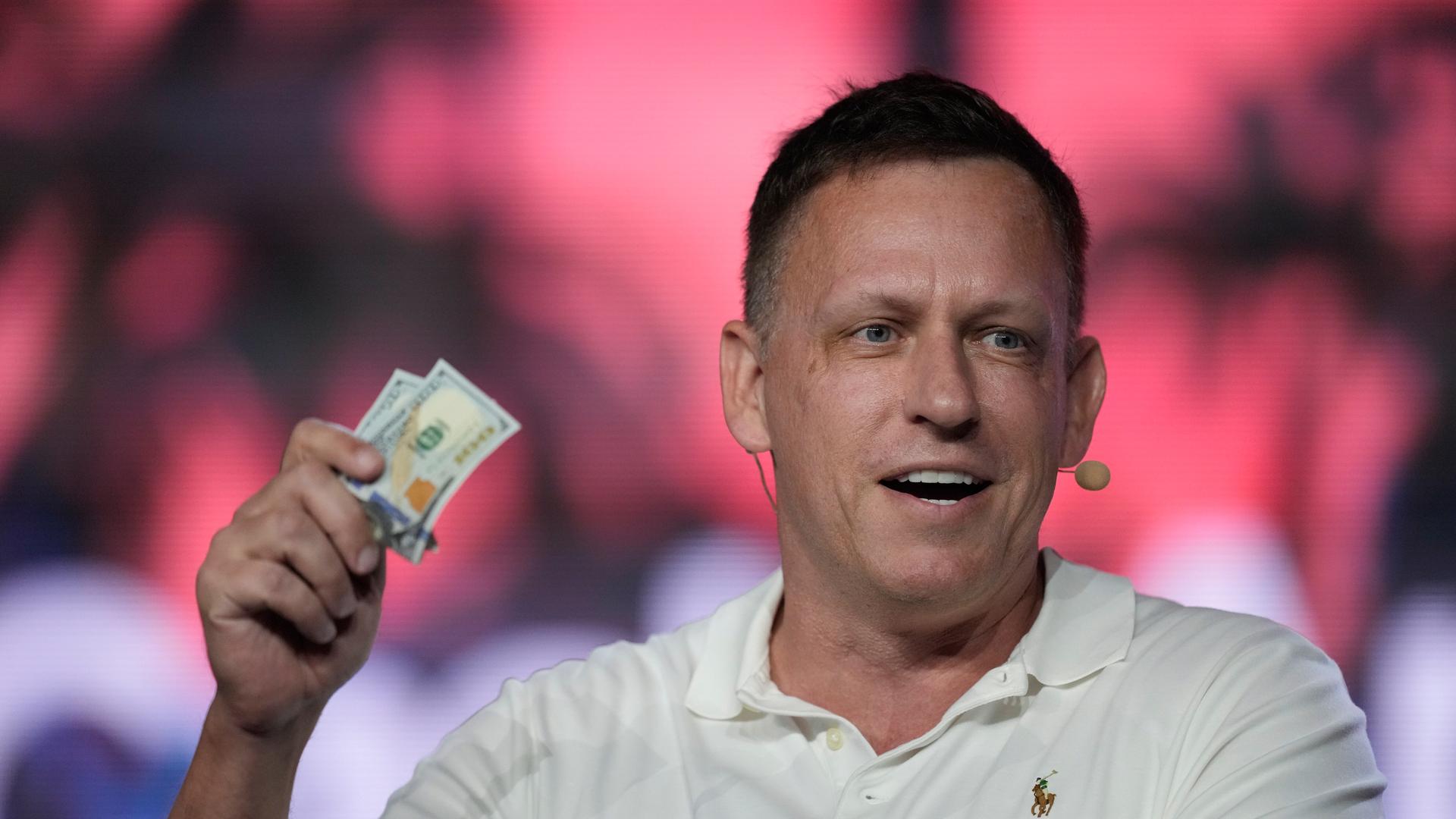
Tech titan Peter Thiel, co-founder of PayPal and Palantir, talks about the Anti-Christ, Armageddon, Apocalypse, morality and the Thessalonian “one who holds back” the Anti-Christ.
What’s remarkable about this is two things: 1) Thiel is not a Christian with Biblical testimony (he’s gay), and 2) As the 103rd richest man in the world who bankrolled Trump’s first campaign, and as the leader of modern warfare tech leader Palantir, Thiel is pillar of modernity with massive influence.
“The slogan of the Antichrist is peace and safety, which is nothing wrong with peace and safety,” Thiel said. “But you have to sort of imagine that it resonates very differently in a world where the stakes are so absolute, where the stakes are so extreme, where the alternative to peace and safety is Armageddon and the destruction of all things.”
Thiel’s world view is influenced more by René Girard‘s mimetic desire than by the Bible. (The theory of mimetic desire posits that people only desire things when they see others desiring those things, creating envy and conflict to compete for the same prize.)
But Girard is his base point, it’s striking how much material he draws from the Bible. It almost seems he’s watched a ton of Chuck Missler videos on the End Times (eschatology) and adopted some of his teachings.
His ample sampling of Biblical apocalyptic material constitutes a stark contrast to the usual dismissive view of elites who deride the Bible. It is bound to drive interest and queries and likely will lead many to Christ, even though Thiel himself is not a Christian in the traditional understanding that includes repentance of sexual sins.
Thiel, now 57, started making money when he helped found PayPal in 1999 alongside Elon Musk. He then funded the rise of Facebook. His latest venture is Palantir Technologies, which uses AI to predict attacks and assess threats, used in warfare, policing and public health. Palantir is being used in Ukraine against Russia and helped predict Covid‘s spread. Forbes pegs Thiel’s personal wealth at $20.8 billion.
Thiel views morality in terms of societal persecution, not in terms of an individual’s lifestyle choices. He fears tyranny through technology and especially the globalization that moves towards a one world government. Hence, he backed Trump’s anti-globalist platform.
Thiel was privately homosexual until Gawker media “outed” him. Stung by the invasion of his privacy, Thiel funded Hulk Hogan‘s lawsuit against Gawker when they made public a private sex tape of the fighter . The resulting $140 million settlement drove Gawker into bankruptcy. Thiel married his long‑time partner, Matt Danzeisen, in October 2017.
Thiel was introduced to Girard’s theories at Stanford University in the 1980s. He has been speaking about Biblical eschatology for two decades.
Of particular interest is his fascination with the katechon, the mysterious force that keeps the Anti-Christ in check for now (2 Thessalonians 2:6-7). Many view the katechon as the Holy Spirit or the church, the force for good that keeps all hell from breaking loose on the planet, and predict that the rapture will remove the katechon and free the Anti-Christ to take over. (The Early Church viewed Roman as the katechon because it held back the forces of Islam and paganism.)
Thiel mentions the katechon frequently. It is a major component in his worldview.
“Thiel is battling for the return of apocalyptic thinking, a profound shift in how we understand history, power, and the limits of human agency,” UnHerd writes. “Modernity, with its faith in inevitable progress and institutional stability, long sought to exile the apocalyptic imagination, viewing it as irrational and disruptive.”
Don’t expect Thiel to preach behind a pulpit any time soon. But his material may drive others to Christ.

4 Comments
Pingback: Christianity making inroads into Silicon Valley – Pilgrim Dispatch News
Pingback: The AI war – Pilgrim Dispatch News
Pingback: We needed to neutralize Iran now, not later – Pilgrim Dispatch News
Pingback: Everybody is wrong. We needed to bomb Iran now. | Mustard Seed Budget