





By Abigail Aguilar —
Naively believing OnlyFans empowers women to express themselves and safely make money, Victoria Sinis worked for an agency that outsourced the money-making chats to Filipinos who pretended to be the star.
Then Victoria went to church, where by chance that day Melinda Tankard Reist spoke about sexual exploitation. Victoria became upset and approached the speaker after the talk.
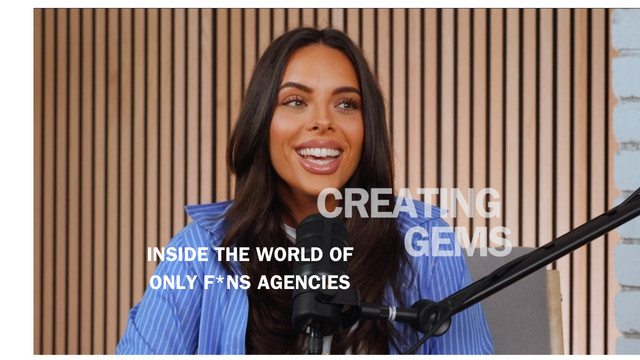
“Hi, my name is Victoria. I work for OnlyFans, and I hate myself,” she said. That same week she quit her marketing job at the agency. She became a Christian and founded Creating Gems, which builds self esteem and girls and warns girls about the lasting dangers of becoming an OF content creator:
- Girls are pressured to do more explicit acts in order to make more money
- Girls will never be able to get their privacy back or remove their explicit content from the Internet
- The money is not as good as girls think, the “glamor” liftestyle turns into PTSD and nightmares
- Girls are jeopardizing their future chances for a job and a happy family life.
“It’s literally just coercing girls and young women into selling themselves and doing porn with this silver platter of eliteness and luxury,” Sinis says. “This is what OnlyFans is doing: It’s pimping, extortion, coercion, grooming.””
OnlyFans launched in 2016 for content creators — like chefs, fitness instructors, influencers, artists — to monetize content. But it quickly transformed into Not Safe For Work content, allowing girls to selling their images straight to consumers with no intermediary.

During 2020, OF exploded. Of course the pandemic lockdowns played a part. Celebrity Bella Thorne made $1M in 24 hours, luring lots of ladies with the smell of fast and easy money. And the spreading of the ideas of Third Wave Feminism with “sex positivity” and let women make money with their bodies.
Only fans subscribers paid $6.6 billion last year (that’s $8 million/day) — enough to fund all public schools for two years. But the average creator earns only $180 a month. That’s where the pressure comes for women to “move beyond their comfort zone” and post kinkier images.
About 1.4 million American women aged 18 to 24 have taken the bait, about 14% of women in that age group. Of women up to 45, approximately 2% of American women are content creators from all walks of life.
On the consumer side, 90% are married men. These statistics are NOT painting a happy picture for the family being the base for society. Married men often have more disposable income than singles.
The allure of OF, as opposed to straight porn, is the supposed interaction consumers can have with the girls. They can communicate with the star of the channel and get a response (for a fee), but almost never is the girl herself doing it.
That’s where an agency comes in, like the one Sinis worked for. They outsource chats to the Philippines, where someone is pretending to be the star chatting. Consumers can also request specific photos or videos, again for a fee, and it’s up to the girl if she wishes to do it.
Since the vast majority of creators make no money, the pressure is on to get more viewers with more risqué content. When the girl breaks down and does what she didn’t previously feel comfortable doing, this is where the trauma takes place, for PTSD and nightmares later in life.
The other way to make lots of money is to do stunts. Lily Phillips filmed herself having sex with 100 men in one day. It did not go well. She cried and dissociated after 10 men. A cameraman gagged at the site of used condoms. Her OF subscribers jumped 80%.
Former top OF model Nala Ray (she made over $10 million) says she needed therapy to overcome the harrowing memories. “I was literally hundreds of thousands of people’s slave,” says Nala, who deleted her account, got married and came to Christ.
Things can get really awkward for creators. Sharna Beckman discovered that her cousin was subscribed to her page, which made her feel “sick to my stomach.” Upon confronting her cousin, he made a lame excuse that somebody had used his name and card.
Ari Taylor, a mother whose OF content was shared by a school bully to harass her daughter, Kay. Sara Cheek, a Tampa Bay mother and OF creator, saw her family harrassed; her son was banned from a sports complex due to her online activities.

Conservative podcaster Amala Ekpunobi says OF is being pushed on young girls. Videos pop up of young girls showing their bank account and how much they make; the videos are delivered via social media to girls as young as 13 years old.
“If you do OF, you’re not going to feel good about yourself,” says Mikaela Peterson. “The person is rare who does that and says, ‘Yeah, I’m fine.’ I think that saying that’s fine is a lie.”
The emotional toll of OF work can linger. Creators report feeling objectified, pressured to push boundaries, and emotionally drained by subscriber demands, which can impact their mental health and relationships post-platform. Marriage might represent a fresh start, but the resurfacing of past content could reopen these wounds, especially if used to shame or harass.
The allure for girls may be money, but most of that will be squandered, experts say. In general, sex workers have a hard time saving for the future for a couple of reasons: Firstly, saving implies thinking long-term, antithetical to the get-rich-now ethos of OF. Secondly, the guilt and disgust girls feel when they expose themselves makes them want to spend on themselves to make themselves feel better.
Related content: Who will tame the worldwide sex trafficking industry, dominatrix spanked men’s bottoms, the thorny issues of Epstein‘s ‘list.’

2 Comments
Pingback: Creator says traffickers recruit on OnlyFans | Mustard Seed Budget
Pingback: Venmo sugar daddies – Pilgrim Dispatch News