




By Abdul Masih —
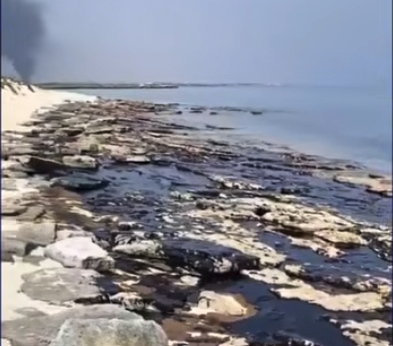
With no place left to store its oil, Iran appears to be dumping oil into the Persian Gulf off exporting centers Kharg Island, the coast of Bandar Rig and the coast of Bushehr.
It’s been a month since the United States countered Iran’s seizure of the Strait of Hormuz with a naval blockade, which has turned back some 70 ships to and from Iran, cutting off its oil exports.
If Iran wished to provoke pain to the United States through worldwide recession, it doesn’t seem to have taken into account its own pain from its own export of oil. Iran received up to $150M daily from oil exports — up to 25% of its total GDP.

Trump and Israel found out that decapitating ~40 top Iranian leaders (including Supreme Leader Ali Khamenei) didn’t catalyze regime change. Fortunately, they had a Plan B.
For decades U.S. military analysts warned that Iran closing the Strait of Hormuz was their lynchpin victory strategy. But what put pressure on the world also puts pressure on Iran.
Videos leaked from Iran show the misery. A soldier reports he’s no longer getting paid money; he’s paid a potato a day and some pickles to eat.
There are plenty of crazed fanatics following Shi’ite ideology that embraces martyrdom and believes that chaos will spark the return of the Mahdi. There are also plenty of people who are simply doing a job, and when they can’t put dinner on the table or can’t pay their rent or heating bill, it’s game over for the regime.
U.S. Treasury Secretary Scott Bessent reported that Iran’s oil storage facilities are maxed out. Iran has scrambled old tankers to sit off the coast to store the excess oil, which may be leaking (?) accounting for the growing oil slick that is now an ecological disaster.
Iran has attempted to scramble other means for exporting oil. There’s the railroad to China. They have tried shipping it to Pakistan to circumscribe the U.S. blockade. They’ve tried shipping via the Caspian Sea. But they don’t have the infrastructure to replace since Kharg Island is the hub for 90% of their export capacity.
Shutting down oil wells is NOT as simple as turning off a faucet. Likewise, restarting them is a complex engineering problem.
Oil reservoirs are underground pressure systems that pushed upward by natural means like gas, water or the weight of surrounding rock. If production stops improperly, pressure can change in ways that permanently reduce how much oil can ever be recovered. In some fields, once pressure is lost, a large portion of the oil becomes trapped forever.
When oil stops flowing, wax, asphaltines, salt, sand or mineral scale can harden inside the wellbore and clog it. Restarting later may require expensive intervention or may become impossible.
Oil fields often produce natural gas along with crude. If production halts suddenly, pressure can spike, gas pockets can migrate unpredictably or dangerous blowout conditions can emerge. Operators must carefully balance and vent systems.
In the case of artificial pressure from electric pumps, steam injection, gas injection, water flooding or heating systems, turning these systems off abruptly can damage equipment and destabilize the reservoir.
Heavy oil can harden once it stops flowing, and pipelines and wells can become clogged almost like arteries hardening with plaque.
Right now, it’s in Trump’s best interest to wait (extend the ceasefire) and choke Iran (via the blockade). What the U.S. bombs couldn’t do, Iran’s economy will.
When the Iran affair is over and done with, analysts will see that it started and ended with Iran’s economy.
Sources: Tousi TV, ChatGTP provided explanations of oil well engineering, others

1 Comment
Pingback: We needed to neutralize Iran now, not later – Pilgrim Dispatch News