




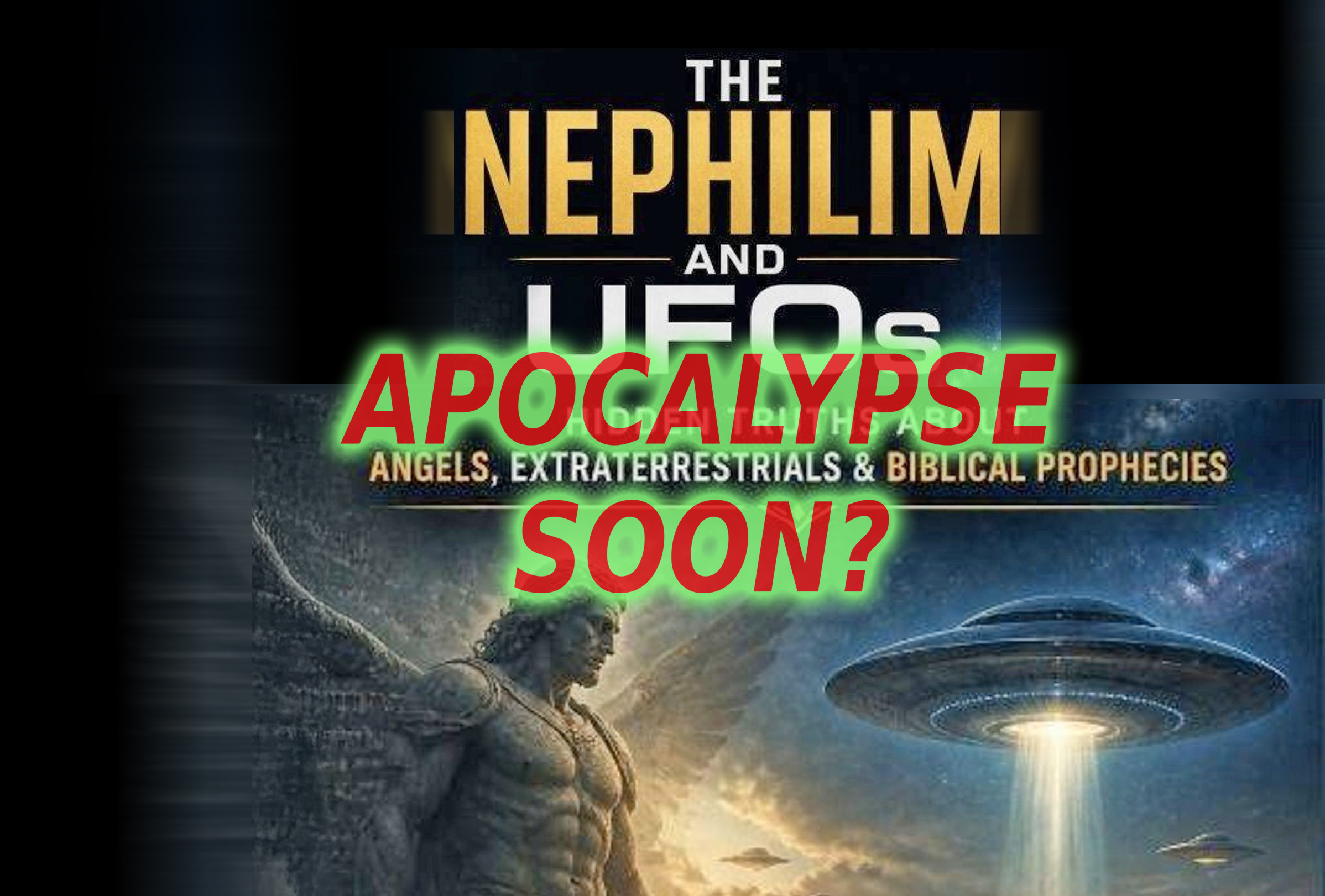
For most of the past century, UFOs occupied an uncomfortable place in American culture.
The subject lived somewhere between science fiction and conspiracy theory. Respectable people generally avoided it. If a politician brought it up, reporters smirked. If a pastor preached about it, church members quietly wondered whether it was time to find a new congregation.
Then Washington changed the conversation.
Congress held hearings. Military pilots came forward. Intelligence officials began speaking publicly. Government agencies stopped pretending unidentified aerial phenomena did not exist. What was once treated as fringe speculation slowly migrated into the realm of public policy and national security.
No one seems entirely sure where the story ends.
That uncertainty has produced two very different reactions inside the evangelical world.
One group watches the developments with growing excitement. They see possible prophetic significance in every new revelation, every leaked report, every statement from a former government insider. For them, disclosure appears to be moving history toward a destination Scripture anticipated long ago.
Another group is uneasy.
Not because they doubt strange things exist. Christianity has never struggled with the concept of non-human intelligence. The Bible is crowded with angels, demons, principalities, powers, heavenly messengers, and spiritual beings that operate beyond ordinary human perception.
Their concern is something else.
They worry that many believers have become captivated by the mystery itself.
In prophecy circles, few voices have been more influential in shaping that discussion than author and filmmaker L.A. Marzulli. For years Marzulli has argued that the UFO phenomenon should not automatically be interpreted as extraterrestrial. His work frequently points readers back to Genesis 6, the Nephilim narrative, and biblical accounts involving spiritual entities. While his conclusions remain debated even among fellow Christians, his larger concern has found a growing audience.
What if the modern world is misidentifying a spiritual phenomenon as a technological one?
It is a question that resonates with many believers who look at recent disclosure efforts and see more than politics or aerospace engineering.
Yet even among Christians sympathetic to Marzulli’s concerns, another warning has begun to emerge.
The real danger may not be deception.
It may be distraction.
That distinction matters.
A generation ago, Christians worried about secularism. Today many seem exhausted by information itself. Every week brings another podcast promising hidden truths, another influencer claiming insider knowledge, another video explaining how current events fit into an elaborate prophetic timeline. The result is often less clarity than confusion.
Some pastors privately admit they spend as much time helping church members process internet theories as they do helping them navigate traditional spiritual struggles.
One ministry leader described it bluntly: “People know more about alleged underground facilities than they do the Sermon on the Mount.”
The observation draws uncomfortable laughter because it contains a grain of truth.
The Bible’s first temptation involved knowledge.
Not forbidden pleasure.
Not political power.
Knowledge.
The serpent offered Eve access to information she did not possess. The appeal was intellectual before it was moral. Hidden understanding. Secret insight. A deeper level of awareness.
That pattern still exerts a powerful pull.
The disclosure movement, regardless of what eventually proves true or false, trades heavily on the promise that somebody somewhere possesses information capable of changing everything.
Christians are hardly immune to that attraction.
Social media has only amplified it. Entire ecosystems now exist around decoding mysteries. Algorithms reward urgency. Fear spreads faster than patience. A sober analysis of a congressional hearing will struggle to compete with a thumbnail promising proof that civilization stands on the edge of collapse.
Over time, fascination can become a habit.
And habits shape attention.
That concern surfaces repeatedly in discussions about biblical discernment. Several Christian teachers have noted that Scripture never instructs believers to become experts in darkness. It instructs them to test spirits, exercise wisdom, and remain anchored in truth.
There is a subtle difference.
One approach studies evil in order to understand it.
The other studies God in order to recognize evil when it appears.
The distinction sounds simple. It is not.
Consider the story of the twelve spies in Numbers 13. All twelve men saw giants. All twelve saw fortified cities. All twelve returned with evidence.
Ten became consumed by the obstacle.
Joshua and Caleb focused on the covenant.
Modern Christians often find themselves facing a similar choice. News headlines, disclosure claims, and endless speculation can become so large that believers begin viewing themselves through the lens of the threat rather than through the lens of God’s promises.
The giants become the story.
The covenant becomes the footnote.
That inversion may be more spiritually dangerous than whatever eventually emerges from government investigations.
This does not mean Christians should dismiss disclosure. Serious questions remain. Governments are asking them. Journalists are asking them. Military officials are asking them.
Believers should not fear facts.
They should not fear investigation either.
Christianity has survived scientific revolutions, archaeological discoveries, world wars, political upheavals, and countless failed predictions about the end of the world. The faith has never depended upon the absence of difficult questions.
What concerns many pastors is not curiosity but imbalance.
When disclosure becomes a larger topic than discipleship, something has shifted.
When speculation generates more excitement than the Gospel, something has shifted.
When believers spend hours studying rumors but struggle to spend minutes in prayer, something has shifted.
Perhaps that is why some Christian leaders have begun steering the conversation back toward a simpler question.
Not whether strange objects exist.
Not whether governments know more than they are saying.
Not whether disclosure will continue.
Those questions may eventually receive answers.
The more pressing question is what kind of people Christians will become while they wait.
History suggests that every generation encounters mysteries that seem capable of reshaping the world. Some actually do. Most fade with time.
The Church endures because its foundation was never secret knowledge.
It was never hidden documents.
It was never access to privileged information.
Its foundation was Christ.
If disclosure eventually proves as significant as its advocates believe, Christians will confront that reality as they have confronted every other upheaval in history.
Not by panicking.
Not by pretending difficult questions do not exist.
But by remembering that no revelation emerging from Washington can be more consequential than the One already revealed.

1 Comment
Pingback: Are aliens the return of the Nephilim? | Mustard Seed Budget