





By Kirollos Abdalla —
At every point along the (now) 10 days of uprising in Iran, international observers have predicted cynically what inevitably happens with demonstrations: a quick and deadly crackdown.
But now the unthinkable: For the first time in the history of the iron-fisted regime, the police have laid down their weapons and joined the people.
“A huge number of police officers have started to stand down and put down their weapons and join the revolution,” reports Mayhar Tousi, a UK journalist with extensive contacts in Iran. “We’ve also had a number of IRGC bases, Islamic buildings and city halls taken over by the Iranian people… This is unbelievable. It has never happened in the history of the Islamic Republic.”
The people continue to dominate, unstopped by the regime, in the capitol city, Tehran. In Abdanan, demonstrators took over a police station, and cops, instead of fighting, surrendered their weapons and joined the uprising.
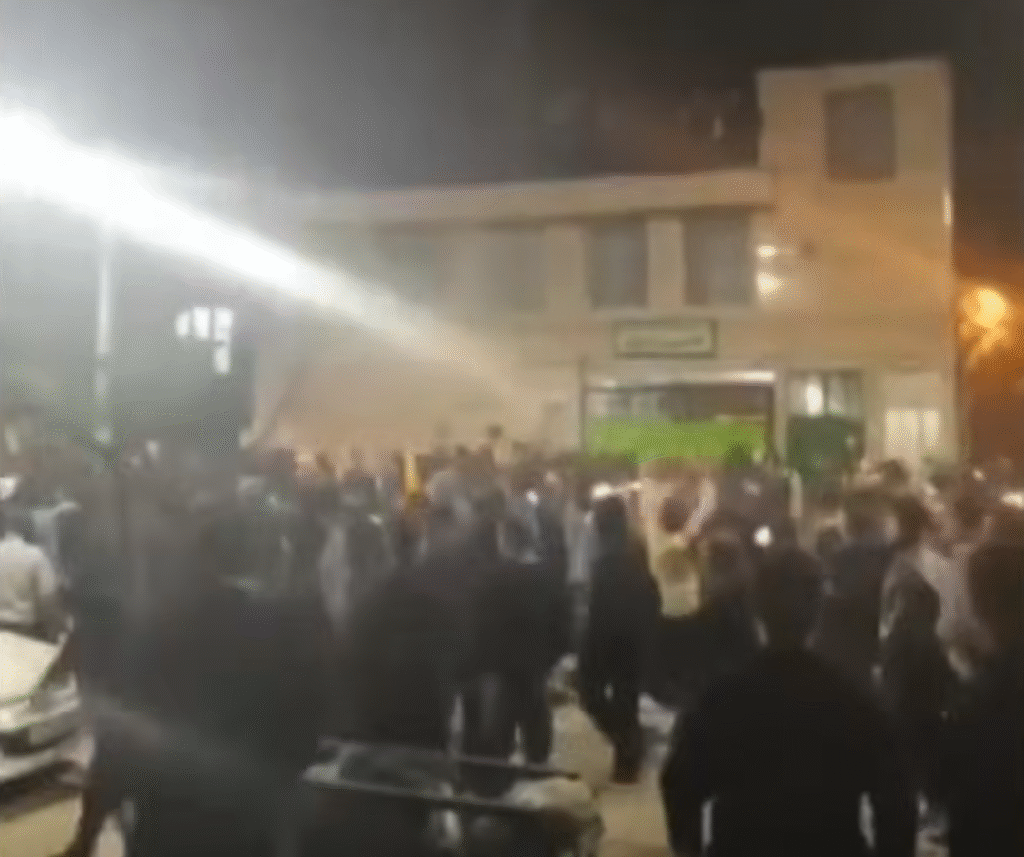
“The police are now with the people,” a protesters says in Farsi as he films. His words were translated by Tousi.

The uprising started in the Tehran central market, once a strong point for the regime.
For almost five decades, the regime has legitimized its oppressive rule by appealing to Islam. But now the younger generation, disenchanted with Islam, is abandoning the religion of their parents in droves. Two-thirds of mosques — 50,000 — have closed due to lack of attendance.
“Death to the dictator!” they chant in the streets.
Both Israel and the United States have vowed to protect with military action the peaceful protesters against a severe Iranian crackdown.
“The Islamic Republic survives on isolation and abandonment. Every time the world looks away, the regime kills in the dark. Every time the world speaks up, however, it loses confidence and ultimately control,” says journalist Emily Schrader. This isn’t a protest wave. It’s a national uprising with momentum, organization and a clear political demand. The Iranian people don’t want reform. They want the end of the Islamic Republic.”
The recent spate of protest is the fourth time Iranians have taken to the streets to take on their repressive Islamist leaders. They also demonstrated in 2017, in 2019 and in 2021, and a total of 3,500 people have lost their lives in the attempt to win democracy.
“The protest have become broader, more political and more socially diverse,” says Navid Mohebbi of the U.S.-based National Union for Democracy in Iran (NUFDI). “It’s no longer upper middle class, middle class or lower class. Everybody is coming out to the streets.
“The protesters have the upper hand in Iran,” Mohebbi added.
Sources: Tousi T.V., JNS, others.

4 Comments
Pingback: Chelsea star followed the star to Jesus – Pilgrim Dispatch News
Pingback: 2,000 Iranians feared dead, still the people won’t quit – Pilgrim Dispatch News
Pingback: At center of mayhem, one Iranian cleric – Pilgrim Dispatch News
Pingback: Here comes the cavalry charge – Pilgrim Dispatch News