





By Zion Jenkins –
Because of Hindu beliefs, Bharath Samrat, born with femoral dysplasia, was called a curse and at 16 wanted to end his life.
“If a person. especially a boy, the firstborn is born physically or mentally challenged, it’s usually considered a curse from god, so that was hard to deal with,” Bharath says. “When a baby is born in a family, it usually brings a lot of joy and happiness, relationships are healed, and people come together. I only brought tears of sadness.”
Born in Bangalore, India, Bharath grew to reject his family’s Hindu beliefs. He eventually accepted Christ, who healed him internally. He has attained an engineering degree from the University of Calgary. He drives and has climbed Mount Kilimanjaro, the tallest peak in Africa.
The femoral dysplasia means his shin bones are connected to his waist. He’s 3’7”.
He walks by swinging his legs, which is a substantial advance over the doctors’ diagnosis when he was born that he would never walk be mentally impaired and probably not live long in childhood.
Still, learning to walk was not enough of a consolation. He envied friends at the public school who could participate on teams, ride bikes and were tall.
His parents supported him, especially his mother. This, too, only went so far to provide him a reason to live. In fact, his depression grew to the point where he contemplated suicide.
“I thought I was the problem and because of me everybody else is facing problems,” he tells. “So the best way to solve the problem is get rid of the problem. I wanted to kill myself and that’s the end of
all the problems, and my younger sister and my parents would be happy.”
When his mother died of cancer in 2003, Bharath had even more reason to not believe in God.
“I was really mad at God. I thought if there is a god, I’m really mad at him. First you make me like this and then you take the only woman who loved me so much,” Bharath said. “For her I was the cutest and most handsome kid and now she’s not there anymore.”
When he studied engineering in college, he had a Christian buddy who encouraged him to give Jesus a try. “There’s this God, Jesus, who can heal you,” his buddy said.
As a Hindu, Bharath had 330 million gods. What did he need another one for? he asked his buddy.
“He’s not just another god,” the friend replied. “He’s the only God, Jesus Christ.”
“I met his pastor and after a series of conversations, I said okay let me give it a shot. I’ll try this Jesus. If I’m healed, that’s great. If I’m not, there’s nothing to lose.”
He prayed. He fasted. He believed and waited. Bharath even bought a pair of pants for a 6’-tall guy.
“I hung it next to my bed because if Jesus comes in the middle of the night and heals me, I have nothing to wear,” he says. “I was prepared.”
Something funny happened. Instead of being healed in body, Bharath was being healed in his mind and heart.
“My perception of healing was outside- in,” he says. “But Jesus was healing me inside-out.”
So Bharath renounced Hinduism and became of follower of the God who healed his inside first.
“I could see that slow shift of my heart,” he says. “He told me there’s life beyond healing. There’s the kingdom of God.”
When Bharath wanted to continue his engineering studies at the University of Calgary, his father worried a lot but ultimately let him go.
Bharath was starting a new life.
But when he landed in Calgary, the temperature was 25 degrees below zero. There was a foot of snow on the ground.
“A foot high snow is waist high for me,” he says.
His style of walking, by swinging his legs from the hip, was not conducive for trudging through the snow. As a matter of face, he did the work of shoveling the snow by pushing his body through it. Whoever followed in his path found a dug-out path.
Bangalore has hot temperatures. Minus 25 was bone-shatteringly cold for him. Being a human snow plow was pure suffering. He developed calluses on his feet from pushing through the snow.
God encouraged him through the hard times.
“To beat it, you have to face it,” Jesus told him.
Throughout all his life, people told him not to dream, that he couldn’t do things. They even laughed at him for daring to dream big things.
The laughter and the negative predictions over his life became the motivation to prove them all wrong. He got the degree, got the job in Canada. He learned to drive with adapted hand controls.
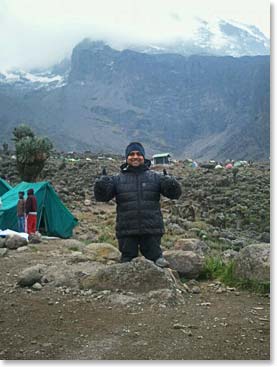
Then he climbed Kilimanjaro, a 19,341-foot-high peak in Africa. He had a team of Christians to help him to the summit.
“When I came to Jesus, he says You can do all things through me, my grace is sufficient for you, you’re fearfully and wonderfully made,” Bharath says (paraphrasing Phil 4:13, 2 Cor. 12:9 and Psm 139:14). “So I started to believe. I wanted to prove wrong all the negative things that I was told to believe.”
So training was undertaken. A crew of support was set up. Tickets were purchased, along with gear. But when he looked at the astoundingly high peak, he shuddered and began to doubt.
“God, I cannot do it myself,” he whispered in prayer. “He told me yes you can, but I’ll help you.”
Then “every time I looked at the peak, I said to my crew, When we reach the top, we’ll worship Jesus.”
He experienced more at the summit than just worship.
“For a second or a few seconds, my whole life flashed in front of my eyes. Thirty years ago, I was told I would never walk in my life and here I am,” he retells. “Jesus chooses the weak, the tiny, the shameful of this world to glorify his name.
“I wish my mother would have been alive to see that day,” Bharath adds. “She would have been a proud lady.”
Related content: He found purpose in pain (from spinal muscular atrophy), Hindu gods couldn’t help anorexic, British swami found Jesus at a bookstore, from Hindu to Muslim to Christian.
