




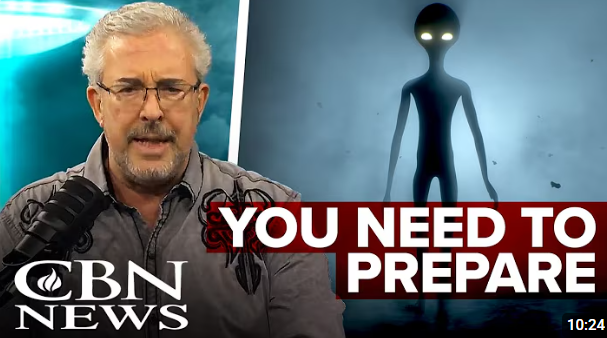
There was a time when Christian evangelical media teachers could disagree with one another without immediately treating the disagreement like a five-alarm fire. That instinct now feels increasingly rare.
The uproar surrounding Perry Stone’s recent viral podcast on UFO disclosure exposed something larger than a dispute over unidentified aerial phenomena or how UFO facts and speculations are increasingly linked to biblical prophecy. Indeed, Stone’s viral moment exposed a growing fracture inside American evangelicalism itself. One fueled by distrust, internet tribalism, political exhaustion, and a culture that increasingly rewards public conflict over patience.
Stone’s original comments spread fast across YouTube and Christian media circles after he discussed private briefings involving believers connected to military, intelligence, and government worlds. According to Stone and others who later corroborated parts of the story, church leaders were being quietly encouraged to prepare for possible future disclosures involving UFOs or what the government now calls “non-human intelligence.”
That alone would have guaranteed controversy.
What followed afterward was more revealing.
The backlash did not come mainly from secular skeptics or atheists. It came from other Christians. Christian podcasters. Discernment ministries. Bible teachers. Online personalities. Men who, on paper, occupy broadly similar theological territory suddenly turned their attention toward dismantling Stone publicly and aggressively.
Some accused him of exaggeration. Others implied recklessness. A few treated the story itself like proof that modern prophecy ministries have drifted into spectacle and sensationalism.
But buried underneath the outrage was an uncomfortable truth many critics avoided acknowledging.
Perry Stone’s broader framework is not remotely new within charismatic or prophecy-oriented Christianity.
For decades, Christians have debated whether the UFO phenomenon could involve spiritual deception rather than extraterrestrial life. Long before congressional UAP hearings became mainstream television content, prophecy teachers were discussing Genesis 6, fallen angels, the days of Noah, and the possibility that end-times deception might involve signs appearing in the heavens.
One does not have to agree with those interpretations to admit they have existed inside segments of evangelical Christianity for generations.
Stone simply stepped into a cultural moment where those older ideas suddenly collided with a modern America already drowning in distrust.
And distrust is now the real backdrop to this story.
Trust in government has collapsed.
Trust in media has collapsed.
Trust in academia has collapsed.
Trust in public health authorities collapsed after the pandemic years.
Even trust inside churches has weakened.
Meanwhile, the federal government openly discusses UAPs. Military footage circulates online. Intelligence officials testify publicly about aerial phenomena they claim cannot be fully explained. Congress holds hearings that would have sounded absurd twenty years ago.
Into that atmosphere stepped a prophecy teacher warning Christians not to become spiritually unprepared for whatever narratives might emerge next.
To millions of believers, that did not sound crazy. It sounded cautious.
Critics seized especially hard on Stone’s wording regarding the so-called “secret briefings.” Early descriptions created the impression that active government insiders themselves were conducting these meetings. Later clarifications narrowed that picture somewhat, describing participants more as Christians with connections to intelligence and defense communities rather than official government representatives.
Stone’s critics viewed this as backtracking.
His supporters viewed it as clarification after media distortion.
But in many ways, the argument over wording missed the larger point entirely.
The deeper issue was the sheer speed with which Christians moved into open internal warfare over the subject.
Modern evangelical culture increasingly mirrors the same dynamics that dominate political media. Suspicion everywhere. Constant loyalty tests. Endless calls for discernment that sometimes become indistinguishable from factionalism. Every disagreement instantly escalated into a battle over motives, integrity, orthodoxy, or hidden agendas.
The church now often argues online the same way America argues politically.
And the dividing lines no longer stay confined to doctrine.
Questions about prophecy now merge with arguments about government.
Discussions about spiritual deception overlap with debates about media manipulation.
Conversations about UFO disclosure become entangled with fears about artificial intelligence, transhumanism, institutional corruption, and cultural instability.
Underneath the Perry Stone controversy sits a larger anxiety many Christians already carry quietly.
A growing number of believers sense that the modern world is becoming spiritually disorienting at a speed few institutions seem capable of addressing honestly. Technology evolves faster than moral frameworks. Public narratives change constantly. Reality itself increasingly feels filtered through propaganda, algorithms, edited clips, and competing psychological operations.
In that kind of environment, warnings about deception find an audience.
Not because Christians are irrational.
Because many no longer trust the gatekeepers telling them everything is fine.
Stone’s supporters believe he is raising legitimate spiritual concerns during a confusing cultural moment.
His critics fear he is feeding speculation that damages Christian credibility.
But both sides reveal the same underlying reality: the evangelical world is becoming deeply fragmented.
The old denominational battles matter less now than newer divisions over politics, institutional trust, nationalism, globalism, prophecy, media ecosystems, and cultural strategy. Christians increasingly inhabit separate informational universes even while reading from the same Bible.
That may be the most important takeaway from this entire controversy.
The church is no longer simply debating theology.
It is debating how reality itself should be interpreted.
That is why this story resonated far beyond the normal prophecy audience.
It was never really just about UFOs.
It was about whether believers feel equipped to navigate a world saturated with confusion, secrecy, technological upheaval, and institutional mistrust; indeed, some of this mistrust was well-earned by public health authorities such as Dr. Anthony Fauci and U.S. governmental agencies caught lying about Covid. The extremism of official falsehoods regarding vaccines and Covid origins led to the violation of church and state when notable Blue State governors outlawed church attendance. Later these same Democrat governors allowed millions of Black Lives Matter demonstrators and their liberal allies to flood the streets in violation of social distancing rules they used to suspend First Amendment freedoms of religious practice. Now lingering disagreements among Christians who take differing views on government, corporations and Big Media lead to questions about whether the church can continue to endure any pressure without splintering into hostile camps that characterize the larger society.
And perhaps most importantly, it raised a difficult question many Christians increasingly whisper to themselves privately:
If believers cannot handle disagreement over speculative end-times issues without turning on one another publicly, what happens when the pressures become far greater than this?
