




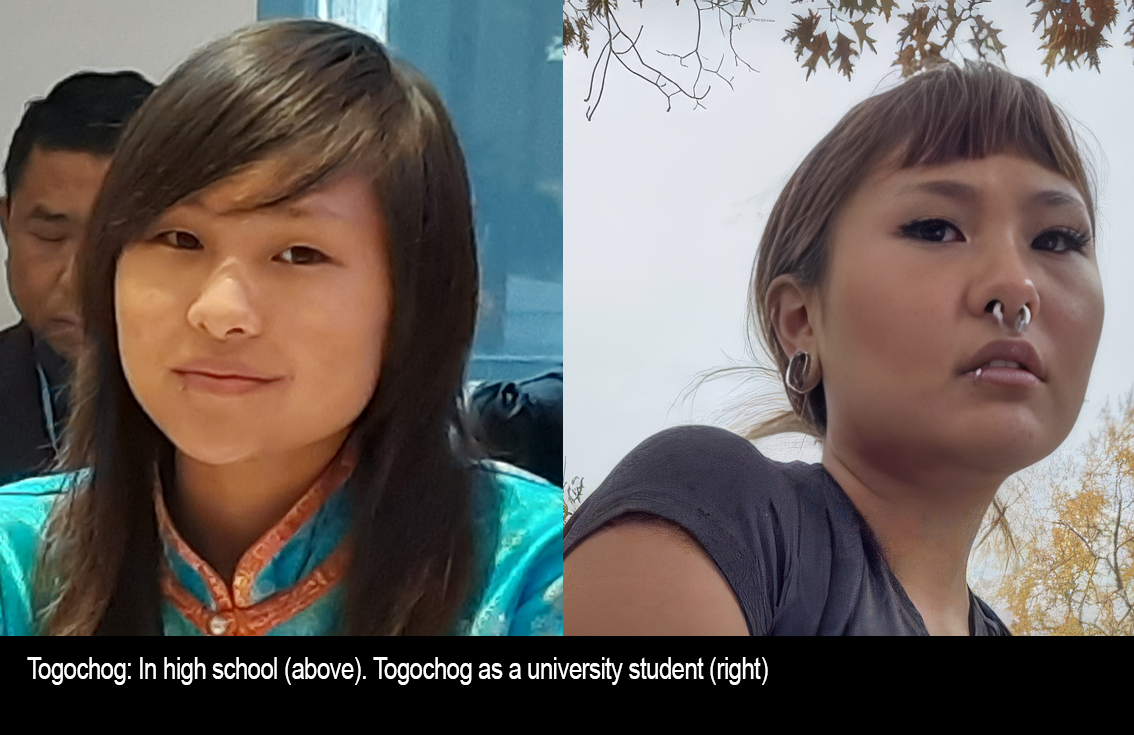
Two young college women have become, in recent weeks, faces of campus violence and intolerance directed at conservative Christians and Jewish Americans.
At the University of Texas, Isa Casahuga mocked Charlie Kirk’s assassination and taunted a conservative speaker about his unprotected neck. At the University of Michigan, Temulun Togochog threatened Jewish conservative commentator Liz Benichou with death after a confrontation caught on video that showed Togochog assaulting Benichou and physically assaulting an arresting officer that led to assault charges.
These two cases served to remind the public that Charlie Kirk’s public killing while exercising his right to speak on a public university campus has plainly not ended the open animosity of many university students opposed to conservative Christian message of Kirk or the pro-Israel advocacy of Jewish organizations on campus.
However, what makes these episodes especially disturbing is the common ground their backgrounds should have supplied: Casahuga’s Catholic schooling presumably taught Christian ethics and compassion, to say the least. But now at the University of Texas, Catholic school alumna Casahuga has found reason to celebrate Charlie Kirk’s defacto Christian martyrdom.
In the case of Togochog, there was her previous very public defense (alongside her refugee Mongolian-Chinese father) of freedom and civil liberties in front of a U.S. congressional panel. She seemed quite appreciative of America on that day.
Indeed, the values these young women had encountered in their formative years in American high schools should have influenced these same women to respect the basic humanity of any speakers they confronted, even across sharp political differences. But these two examples of these two young people are quite common, unfortunately.
But first a step back: violence associated with American campus politics did not begin with Donald Trump. It also predates the Black Lives Matter protests and disturbances that got underway in the late Obama years. Indeed, campus violence, particularly the idealistic Left Wing variety reaches back before social media to the upheavals of the 1960s. The Weather Underground and other socialist student groups emerged from the campus New Left in 1969 and embraced bombings in pursuit of its revolutionary objectives. The passage from campus activism to political violence has a history considerably older than the latest viral video.
For generations, that history has fed an unsettling concern among families: young people leave home for an education and return alienated from the beliefs, communities and country that raised them. For conservative parents, especially those who have invested in a religious education, the prospect carries a particular sting. The institutions entrusted with developing independent judgment can become settings in which your children’s inherited convictions are treated as embarrassments to be discarded- or worse.
In the 21st Century, social media has amplified how these confrontations reach the public. A student with a phone can record an assault, a death threat or the celebration of an assassination and circulate it even if a liberal New York City tv producer or other big city newspaper editor decide to bury such incidents- which they often did for decades.
Indeed, whatever judgments big corporate New York and Washington D.C. news organizations make about campus politics (or anything else), they no longer control which encounters an audience gets to see.
The troubling question is what those increasingly visible encounters reveal about the moral boundaries of American young people, and specifically conservative and religious young people, who later go off to college. Several surveys have found substantial acceptance of violence to stop campus speech among students identifying as very liberal. Indeed, this has become a subject that universities cannot responsibly brush aside.
FIRE and College Pulse surveyed 58,807 college undergraduates in 2024 for their 2025 College Free Speech Rankings. Among students identifying as very liberal, 38 percent considered violence to stop campus speech acceptable at least rarely. Sixty-six percent accepted blocking attendance, and 84 percent accepted shouting down speakers, at least rarely.
And the two recent cases bring the issue into view. At the University of Michigan, Temulun Togochog was arrested following a confrontation in which video showed her attacking Jewish conservative commentator Liz Benichou. On a viral phone video, Togochog can also clearly be seen and heard issuing a death threat toward Benichou. At the University of Texas at San Antonio, Isa Casahuga turned Christian conservative Charlie Kirk’s assassination into a celebratory poem, then reference Kirk’s fatal neck injury in a threatening remark Casahuga directed toward the conservative Christian speaker who allowed her to speak her opinions in a microphone.
For both these young women, their backgrounds deepen the contradiction. Togochog had publicly championed freedoms denied to her father’s people under Chinese rule. Casahuga reportedly attended a expensive private Catholic school whose mission invokes integrity and compassion. These were principles that should have furnished these two young women with common ground with people they confronted, whatever their political differences. Instead, one case produced assault charges and a death threat; the other produced a public performance mocking a Christian’s murder.
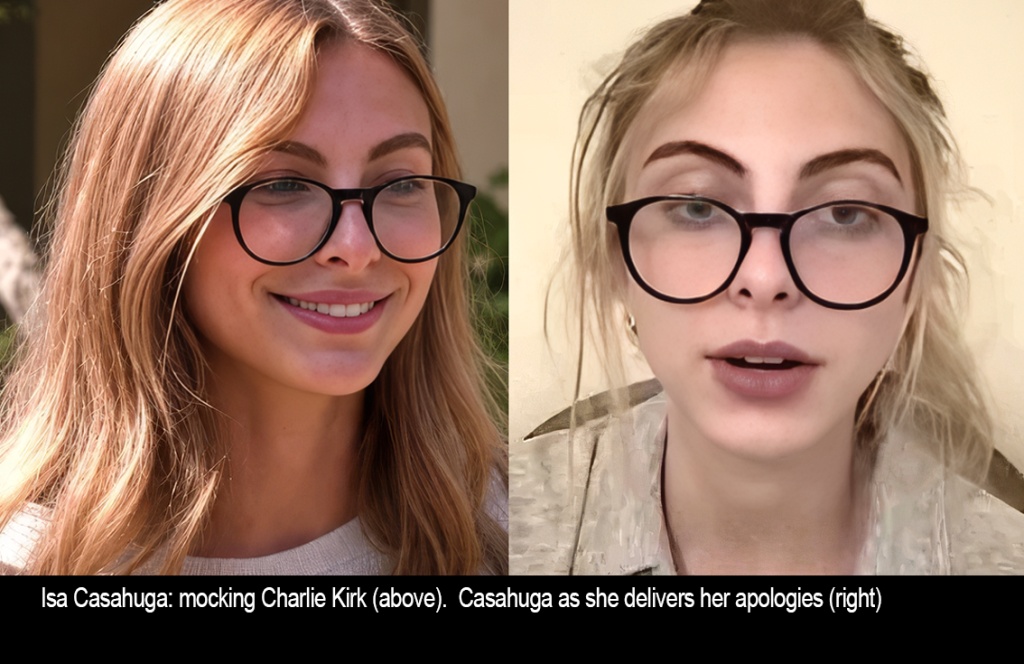
Neither woman’s political development is sufficiently documented to establish when her views changed or who influenced them. What is visible is the collision between the values surrounding their earlier lives and the conduct recorded on campus. But ominously, this scenario keeps happening, as conservative and religious parents have noticed for decades about their kids coming back from university studies with contempt and hostility for these same parents and their values.
At a September 23, 2026, campus event with conservative activist Christian Collins, college undergrad Casahuga read a parody poem about Charlie Kirk’s assassination. According to The College Fix, she referred to the “Kirkiversary” and a “shot to the neck.” Asked whether she was happy with herself, she answered, “Baby, I’m thrilled.”
So now the world witnesses online where Casahuga’s private high school can charge nearly $30,000 a year tuition, state integrity and compassion as it educational goals, train a student to debate and still watch that former student turn a political and religious assassination into a punch line.
And she wasn’t done.
Casahuga directed a veiled threat at the Christian conservative in front of her. The Post Millennial transcribed Casahuga calling Collins “brave” for appearing with “no protection, no nothing, no like neck brace.” After a poem invoking Kirk’s fatal wound, the reference was plainly menacing in context, even though the reporting does not establish a criminal threat finding.
Collins’ pained and measured response to Casahuga was simply to say he would pray for her. The contrast did not require a university education to decipher.
Delving further, Casahuga’s reported background makes the episode seemingly harder to explain away as the product of exclusion or a lack of educational opportunity. Coverage identified her father as a partner at the notable Arthur D. Little consulting firm, and her mother as Houston realtor with a high-end firm specializing in luxury housing.
To be sure, St. Agnes publicly responded to Casahuga by rejecting her remarks as contrary to its values. Casahuga subsequently apologized to Kirk’s family and Collins, acknowledged the hurt she caused – and then Casahuga unexpectedly invoked her Christian faith in stating she was making a public apology after much prayer on her part.
For the record, speaker Collins publicly forgave her. Sincere Christians know that there is no need to speculate whether her remorse was sincere.
A different family history makes the University of Michigan case involving Temulun Togochog equally disturbing.
Her father, Enghebatu Togochog, built a public career opposing political repression. In a 2002 statement to the Congressional-Executive Commission on China, he said he had left his homeland for political reasons in 1998. That homeland was Inner Mongolia, within China, rather than the independent country of Mongolia. In 2022, he testified again about restrictions on Mongolian language and identity and arrests following resistance to Chinese policies.
In December 2024, his American-born daughter appeared before the same commission. Then 17 and identified as a community-college honors student, Temulun described her parents’ exile, their efforts to preserve Mongolian culture and the freedom she enjoyed in the United States.
Less than two years later, she is facing charges following her violent outburst and confrontation with conservative campus speakers.
During the arrest, Togochog shouted, “I should have f—ing killed you when I f—ing had the chance,” according to University Herald.
Togochog’s family had sought protection against political coercion. The daughter had publicly praised freedom. Now she that she has gone off to college, she has been recorded issuing death threats.
To be sure, Togochog’s father (like St. Agnes school) is not responsible for violent university student conduct. The contradiction concerns the principles Temulun herself had previously articulated.
According to court records cited by Jewish News Syndicate, Togochog was arraigned November 4 on a felony count involving assaulting, resisting or obstructing an officer and two misdemeanor assault counts. A not-guilty plea was entered, and she received a $5,000 personal recognizance bond. The charges remain unresolved.
And much like Christian speakers on campus, Jewish students continue to face forms of ideological threats and coercion. The ADL counted 1,694 campus antisemitic incidents in 2024 and 583 in 2025, a substantial decline that should be acknowledged. These figures include harassment and vandalism, not just assault, and these incidents almost always involve left-wing students.
Kirk’s killing remains the gravest event in this account. Indeed, Prosecutors argued that Kirk’s accused killer Tyler Robinson’s personal life conflicted with Kirk’s opposition to same-sex marriage and his religious teachings about sexuality and gender. They alleged that Kirk was targeted for his political expression, even though Robinson has been noted to come from a conservative Christian family in Utah. Notably, Robinson’s attitude toward his family’s values shifted after he went off to study at a local Utah college himself.
If the prosecution establishes that Kirk was killed for publicly expressing his Christian convictions, an interpretation of his death as Christian martyrdom has a clear basis: a believer killed for bearing public witness to his faith. That is a religious and editorial interpretation, distinct from the criminal charges.
But there remains the lingering question: why do University students, even though raised in devoutly religious and conservative families, repeatedly show hostility toward their family, faith and even country? Indeed, why do significant numbers of students turn against the free society that gives them a chance to learn and succeed?
The answer has several explanations but one framework is that of Austrian economist and sociologist Joseph Schumpeter who argued that capitalist societies generate historic wealth that helps more people of all strata and classes attend college- but this does not ensure gratitude toward traditional values.
Often educated people in privileged settings develop alienation and resentments at the very abundant material existence they enjoy. Schumpeter pointed out a hundred years ago that when educated people cannot seem to find psychic or spiritual fulfilment in their affluent and consumer-driven lives, they gravitate to radical and left wing world views that scapegoats society’s traditional values and institutions for their mental pain and anxieties. These privileged and over-educated malcontents then come to blame the system- capitalism, conservative social mores, traditional religion, and established institutions as stifling true liberty and personal actualization.
On a related note, late French philosopher and Stanford University professor René Girard also argued that humans copy each other and compete for respect. Applied to campus life, his ideas suggest that students may compete to seem morally superior by attacking a shared enemy- just as radical political movements such as Marxism require a scape goat class of people (again, conservatives, capitalists, religious people) who are responsible for the ills of society.
Together, these ideas help explain how for angry and radicalized young American university students, material comfort and a privileged background can exist alongside hatred of one’s own society and family traditions. The danger comes when students treat people who defend America, its Constitution or religious beliefs as enemies whose rights no longer matter.
For American families of all faiths or opinions, buying an education for their kids should do more that what has been delivered in the case of Togochog and Casahuga- these young people should be held to account and they should have some understanding of what must never be done to the person standing on the other side of it. And this is the fault of the education institutions most of all.
