





By Jongho Lee –
A 17-years-old American high school student, Shiloh Attoun, discovered a 3,300-years-old Egyptian-style amulet at Tel Gezer National Park in Israel.
The Israel Antiquities Authority (IAA) announced the discovery on November 3.
“I couldn’t believe it was happening to me—a moment ago we were talking about the slim chances of ever discovering such a find, and here was one right in my hand!” Attoun said.
The artifact is a scarab, an amulet shaped like a dung beetle.
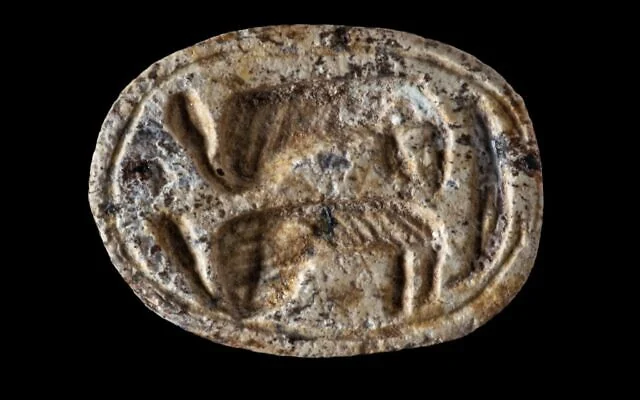
According to Professor Ido Koch of Tel Aviv University, the artifact has two cobras and an Egyptian hieroglyphic symbol meaning “lord.”
This discovery is important because it shows the cultural influence of ancient Egypt on the area that is now Israel and the historical connection between the two regions.
Scarabs were commonly used in ancient Egypt, and they were sometimes used as seals.
Ancient Egyptians believed that dung beetles represented creation and new life. Cobras also symbolized protection and royal power.
Tel Gezer, where the artifact was found, was one of the major cities in ancient Canaan.
It controlled an important crossroads connecting different regions.
Today, this archaeological site is part of Tel Gezer National Park.
Attoun arrived in Israel to study at Muss High School Israel.
Two days later, he joined other students on their first field trip to Tel Gezer National Park.
While the students were walking past an ancient gate and going up a hill toward an altar, Attoun threw a stone.
The stone hit another rock, and Attoun noticed a small, shiny object.
“It looked ancient,” Attoun said. “I picked it up and consulted my guide.”
After that, Attoun and Benji Hain, the school’s dean of students, reported the discovery to the Israel Antiquities Authority.
The IAA gave Attoun a certificate of appreciation for his responsible actions.
The IAA also reminded the public that if they find archaeological artifacts, they should leave them where they are and report them to the authorities immediately.
